GUIDE · 03
CARDS & INTEGRATION
IOTA · BLUEPRINTS · PENALTIES
Card Integration is the half of In Falsus the rhythm game never teaches you. Clear encounters, earn Iota, slot hex pieces into a Blueprint grid, and craft the Cards that turn your chart accuracy into encounter damage. This guide explains every rule, penalty, and multiplier in the system.
What is Card Integration in In Falsus?
Card Integration is the core crafting mechanic in In Falsus used to synthesize and empower playable Cards. Players collect hexagonal Iota drops from cleared Encounters, slot them onto character-specific Blueprint grids, assign bonus Traits, and forge battle Cards whose Power and Defense scale with average Potency and determine encounter damage.
HOW INTEGRATION WORKS (4 KEY PHASES)
- 1. Farm Iota PiecesWin Encounters (Dive Clear) to earn hexagonal pieces defined by Color, Shape, Tier, and Potency.
- 2. Slot into BlueprintCover colored Zones to generate Base Power/Defense while avoiding all 5 placement penalties.
- 3. Assign TraitsPlace Iota carrying bonus traits into open Blueprint Trait Slots for massive combat multipliers.
- 4. Deploy 5-Card LoadoutLink up to 5 unique character cards into a loadout to burn enemy Resolve with every rhythm note.
How to unlock more Cards
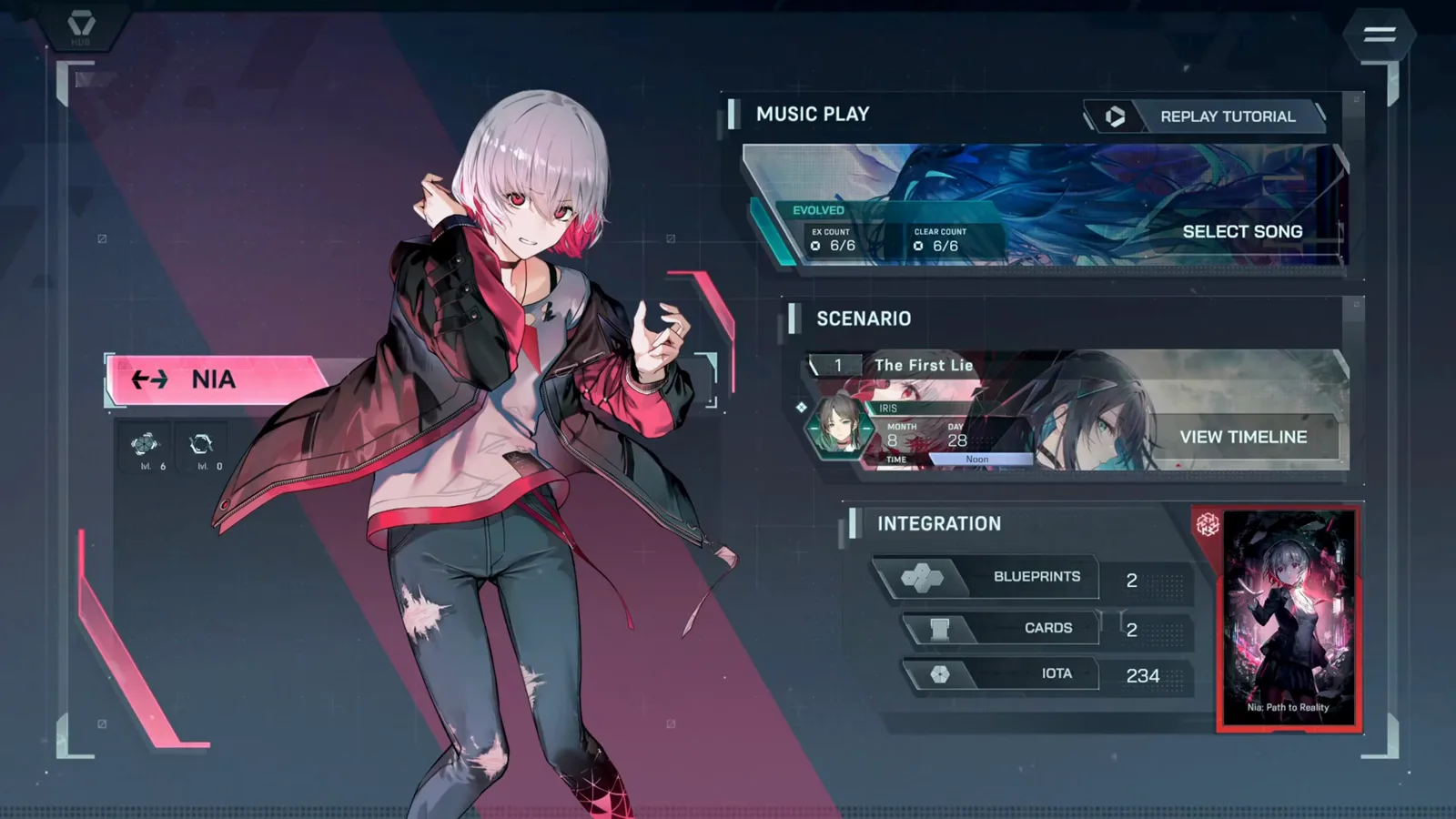
CARDS · UNLOCKSCards unlock by progressing through the Scenario — the same way songs do. The full game lists 50 cards in total; the current demo (v0.3.0, April 2026) ships with two, Nia: Path to Reality and Mei: 4AM, plus the Card Integration menu that crafts more. The hub menu's Integration panel still shows locked entries, so the roster grows with the Scenario.
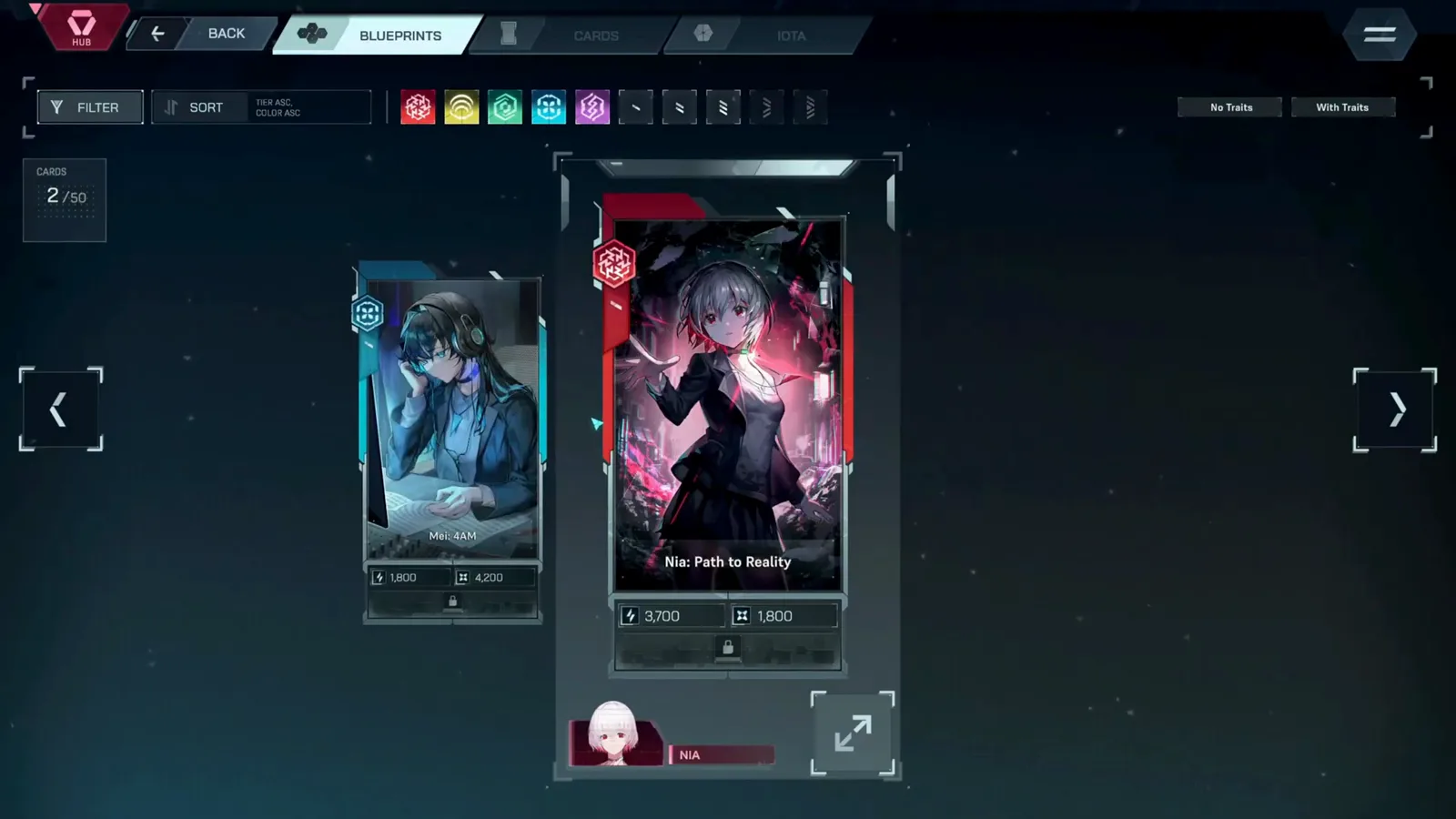
Older demo builds predate Card Integration and simply granted cards, which is why returning players ask where the extra cards went — the confusion has its own thread on the official subreddit. In the current demo, Scenario progression is the only path: r/InFalsus · How do y'all get other cards? ↗
Remembrance, explained
CARDS · SCENARIO LORERemembrance is the label the encounter screen gives each Dive's place in the story. On the loadout screen it sits under the Dive's name, beside the Difficulty Rating, as a number and an in-fiction calendar date: the Ghost Ray encounter “Unclear Dive” (Difficulty Rating 20) reads Remembrance 1 | 10276/8/27.
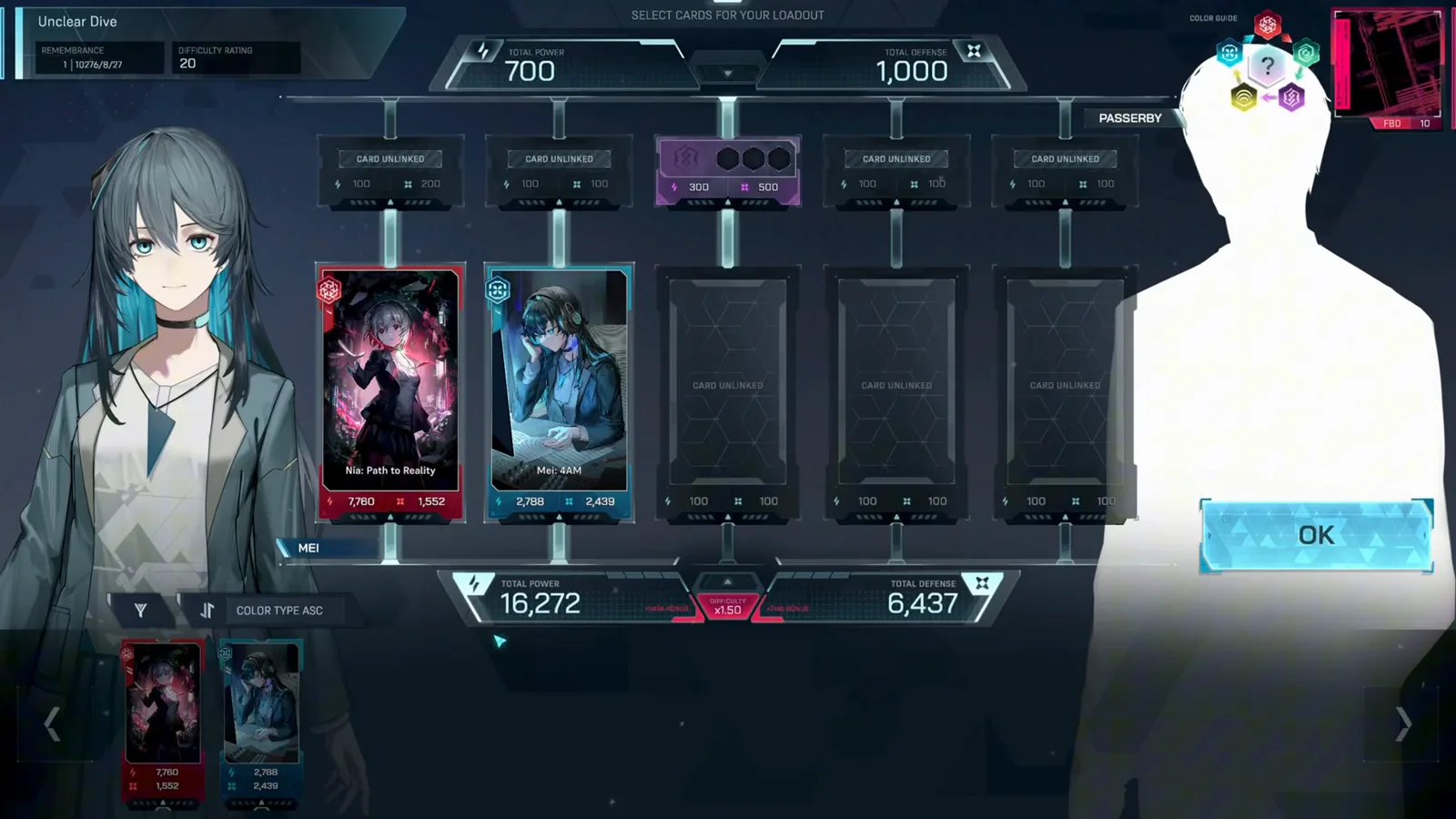
That date format matches the Scenario timeline in the hub menu, where chapter 1, “The First Lie”, is stamped Month 8, Day 28 — a Remembrance pins an encounter to a moment on the game's story calendar, year 10276.
The demo never defines the term beyond that label, and no written guide covers it yet — everything in this section comes from the video walkthrough cited under each screenshot.
IOTA BASICS
CARDS · 01Iota are the raw material of every card — hexagonal pieces that drop from cleared encounters. Each piece is defined by five attributes.
BLUEPRINT ANATOMY
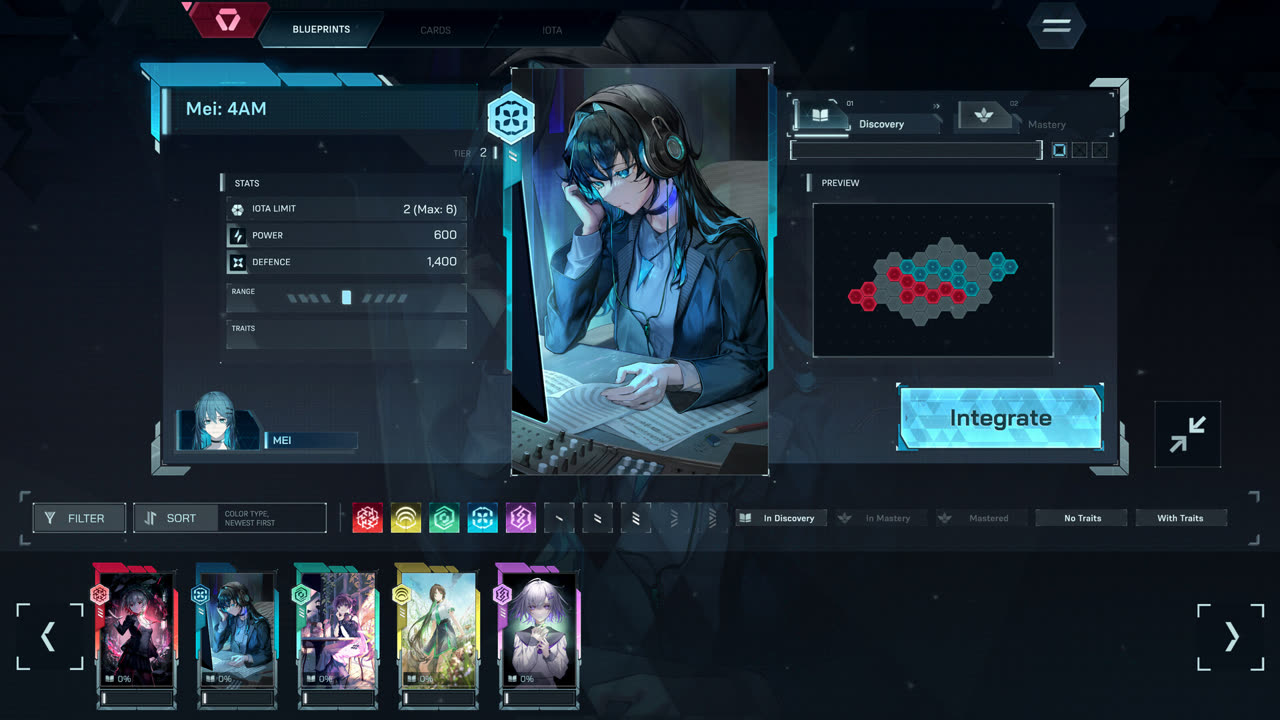
CARDS · 02A Blueprint is the hex grid you build a card on. Three kinds of tiles matter.
INTEGRATION WALKTHROUGH
CARDS · VIDEO BREAKDOWNFrom lowiro's official Card Integration & Encounter Showcase — the full craft-to-combat loop, frame by frame.
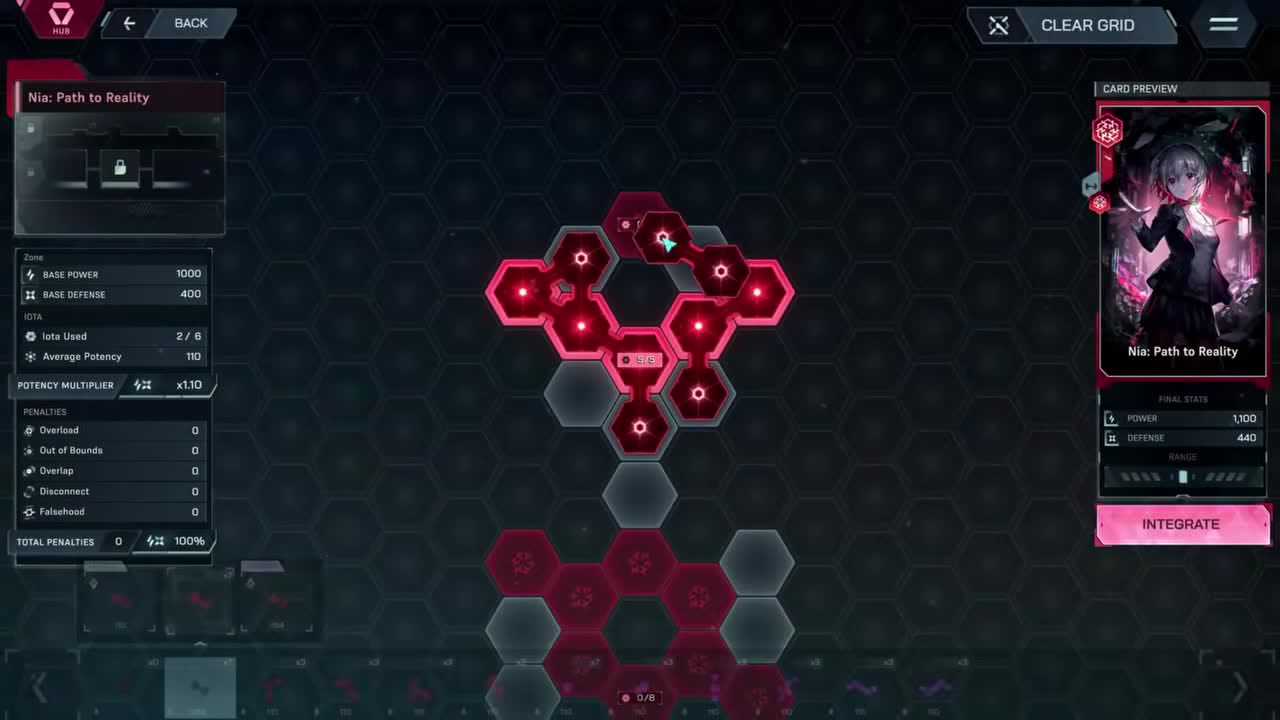
- 1
Slot Iota into the Blueprint grid
Each piece covers the tiles under its shape. Here 2 of 6 Iota sit on Nia's Path to Reality: the covered Zones give Base Power 1,000 and Base Defense 400, Average Potency 110 makes a ×1.10 multiplier, and the penalty list reads all zeros — this layout keeps 100% of its stats.
OFFICIAL FOOTAGE · PLACING IOTA - 2
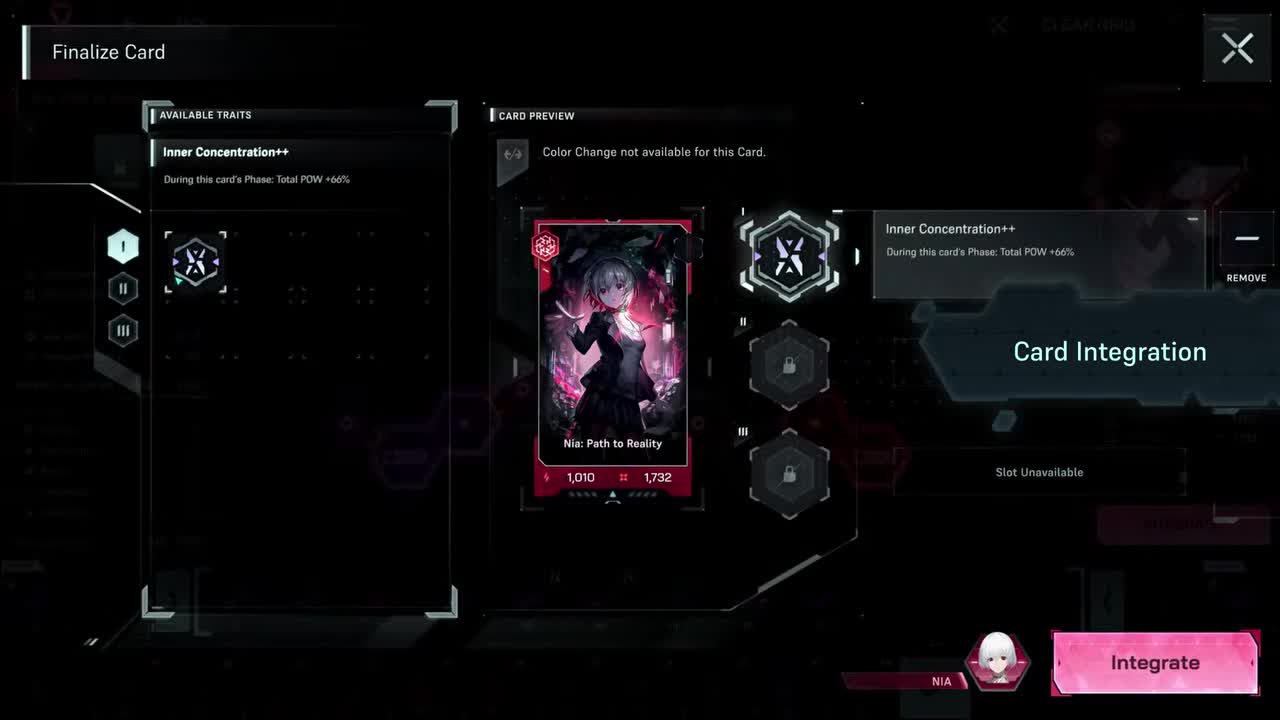
Assign Traits and finalize
On the Finalize Card screen, Iota carrying Traits fill the card's Trait Slots — this build slots Inner Concentration++ for Total POW +66% during the card's Phase. Hit Integrate to lock the craft.
OFFICIAL FOOTAGE · FINALIZE CARD - 3
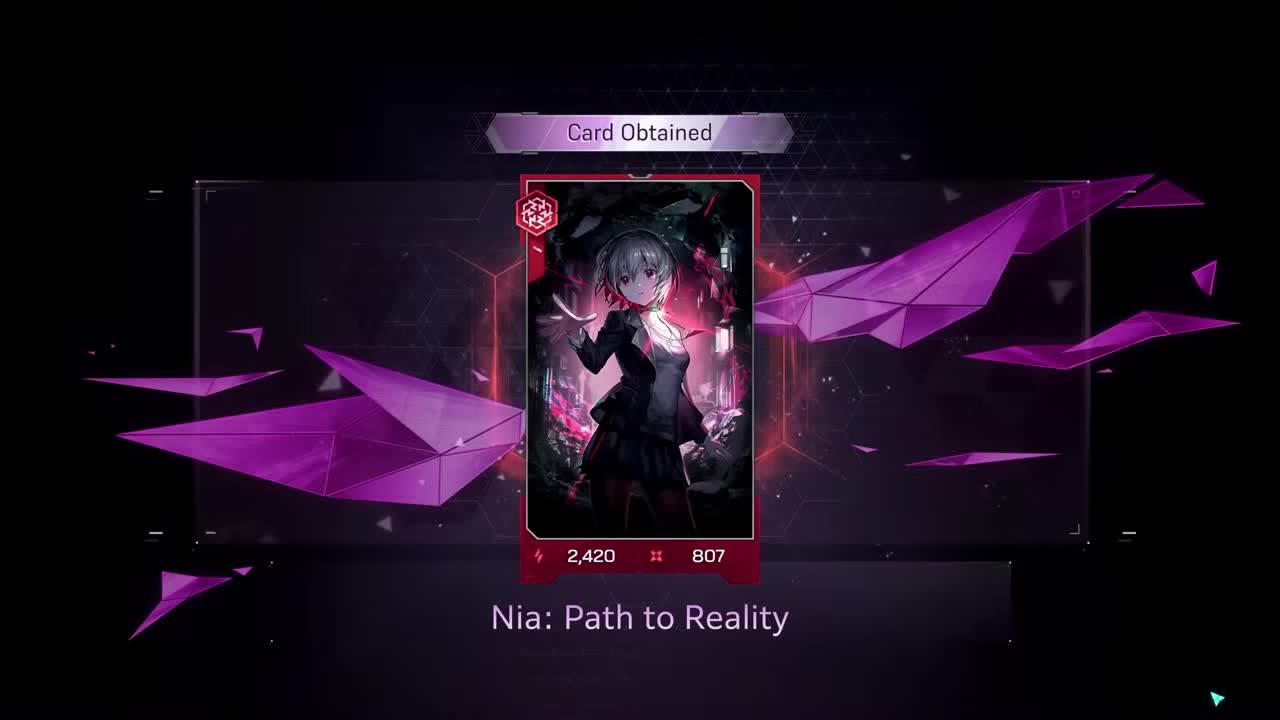
Card obtained
The finished Nia: Path to Reality comes out at 2,420 Power / 807 Defense — filled Zones times the Potency multiplier, with zero penalty reduction.
OFFICIAL FOOTAGE · CARD OBTAINED - 4
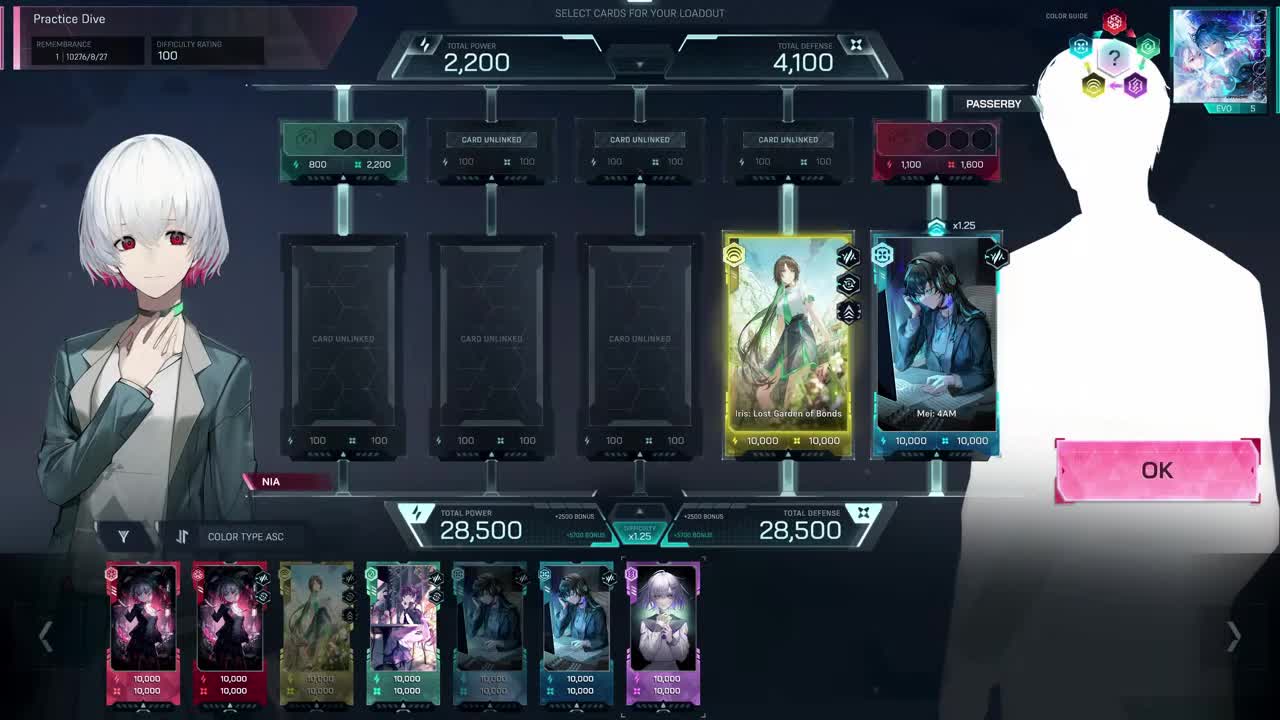
Build a 5-card loadout
Before a Dive you link up to five cards into a loadout and the totals update live — this screen sits at 28,500 / 28,500 with slots still unlinked. Remember the rule: never two cards from the same Blueprint.
OFFICIAL FOOTAGE · LOADOUT SELECT - 5
Connect in an Encounter
The loadout faces the opponent across the chart: your Total Power burns their Resolve with every note you hit while their attacks chip yours. Outlast them to Connect — that is what pays Iota.

OFFICIAL FOOTAGE · ENCOUNTER CONNECT
PLACEMENT RULES
CARDS · 03Four hard constraints govern every layout. Break one and you eat a penalty — sometimes without knowing it.
- Iota Limit — each Blueprint caps how many pieces you can place. Exceeding it triggers Overload.
- No rotation, no flipping — pieces go down exactly as they dropped. Plan around the shapes you own, not the shapes you wish you had.
- Maximum 3 Iota stacked per tile — a fourth piece on the same tile triggers Overlap.
- Power and Defense must both stay above 0 — a card with either stat at zero is not a legal craft.
THE FIVE PENALTIES
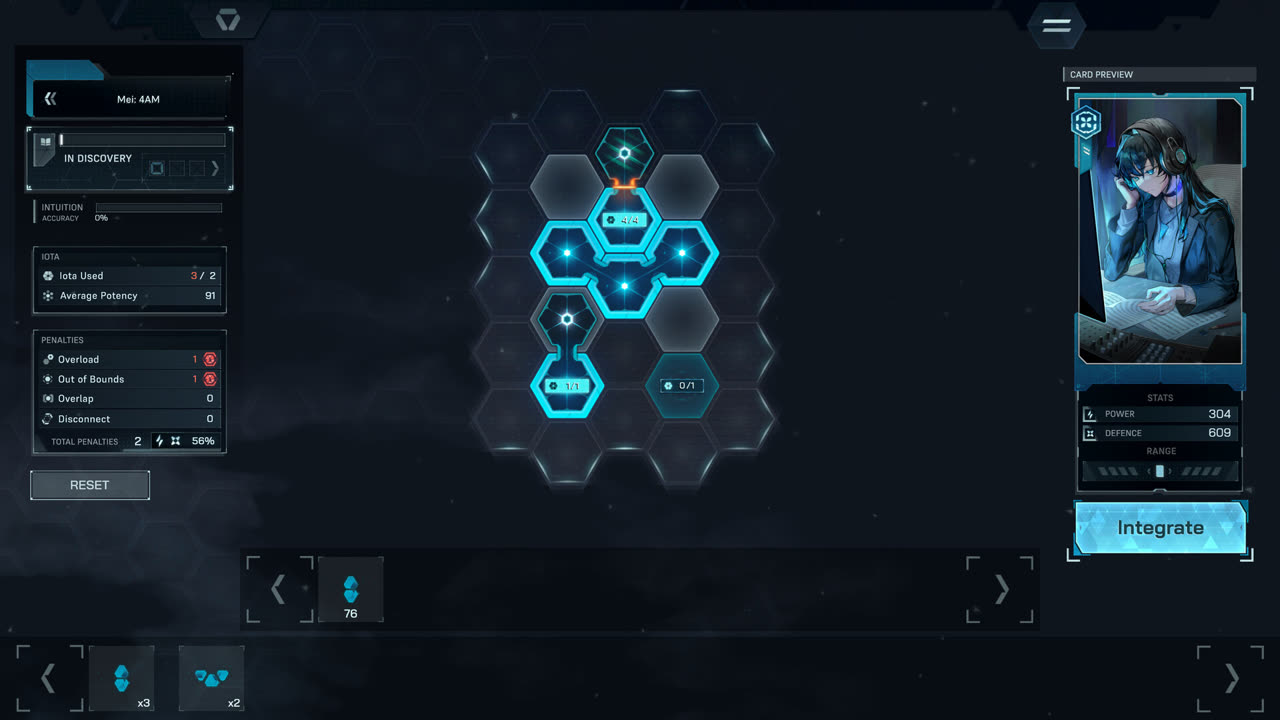
CARDS · 04Penalties multiply down your finished card's stats. Knowing what triggers each one is the difference between a 100% card and a 56% card.
OVERLOAD
Placing more Iota than the Blueprint's Iota Limit allows.
OUT OF BOUNDS
A piece extending past the edge of the Blueprint grid.
OVERLAP
Stacking more than 3 Iota on a single tile.
DISCONNECT
Parts of your layout losing connection to the grid's safe tiles.
FALSEHOOD
A card that touches no safe tile at all. Unlike the others, its penalty is infinite — there is no floor.
Penalty scaling
| Penalties | Stats kept |
|---|---|
| 0 | 100% |
| 1 | 89% |
| 2 | 56% |
| ≥ 3 | 0% |
Penalties stack multiplicatively against your card — at 3 or more, the card is worth 0% regardless of the Iota inside it.
THE DAMAGE FORMULA
CARDS · 05Every crafted card's Power and Defense come out of the same calculation:
STATS = (Σ FILLED ZONES) × POTENCY MULT × PENALTY REDUCTION
POTENCY MULT = AVERAGE POTENCY ÷ 100
Three levers, in order of importance: keep penalties at zero (one mistake costs 11%, two cost 44%), hold your average Potency high, then fill as many colored Zones as the Iota Limit allows. In encounters, Total Power ÷ total notes sets your damage per note, and the Difficulty Multiplier (1.00 + Level × 0.05) scales the payout.
COLOR ADVANTAGE CYCLE
CARDS · 06Colors beat each other in a one-directional cycle worth ×1.25 damage:
Red beats Green, Green beats Purple, Purple beats Yellow, Yellow beats Blue, Blue beats Red — and only in that direction. Attacking against the cycle gets you nothing. Check the encounter's color before you lock a loadout.
EXAMPLE TRAITS
CARDS · 07Traits are bonus effects carried by individual Iota, shown here in their strongest “++” variants.
| Trait | Effect |
|---|---|
| Opening Recovery++ | Heals 11% of Resolve at the start of the encounter. |
| Opening Surge++ | Deals opening damage equal to 0.11 × Total Power. |
| Inner Concentration++ | Multiplies the card's Power by ×1.66. |
| Inner Rigor++ | Multiplies the card's Defense by ×1.66. |
CHARACTER BLUEPRINTS
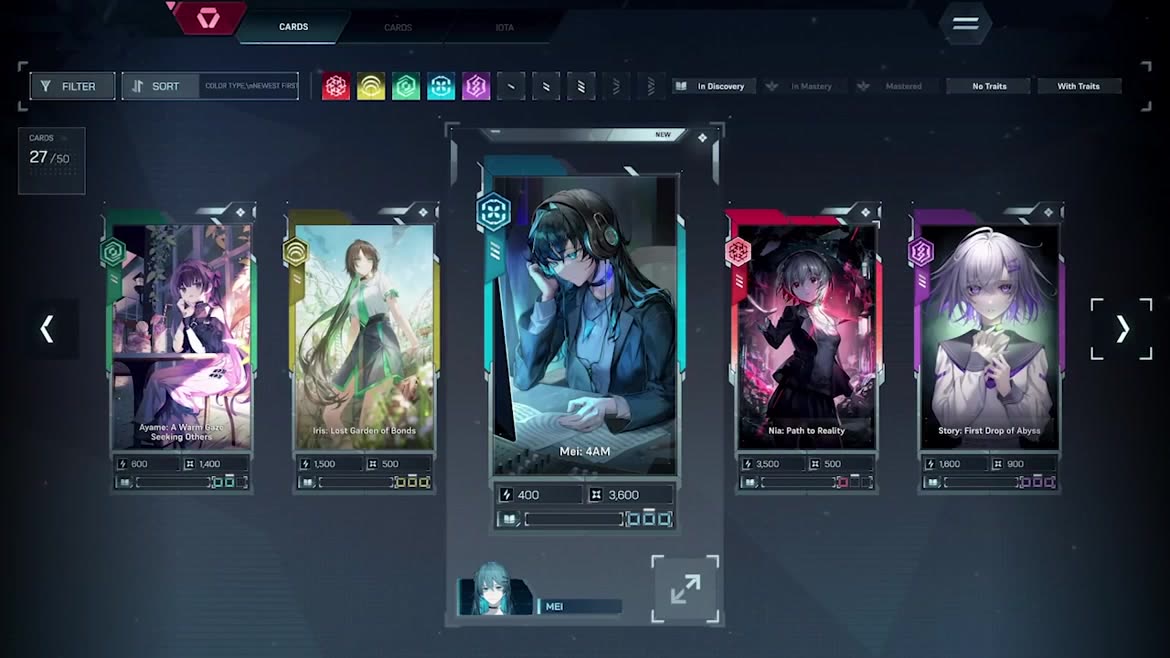
CARDS · 08Each of the five leads carries a named Blueprint with a signature color. Remember: a loadout can never contain two cards from the same Blueprint.
| Character | Blueprint | Color |
|---|---|---|
| Nia | “Path to Reality” | RED |
| Mei | “4AM” | BLUE |
| Ayame | “A Warm Gaze Seeking Others” | GREEN |
| Iris | “Lost Garden of Bonds” | YELLOW |
| Story | “First Drop of Abyss” | PURPLE |
Infusion & Core Skills
A character's Infusion skill gates which Iota tiers you may slot per color — higher Infusion, higher usable tiers. Core Skills add tolerances that soften the placement rules, letting a layout get away with what would otherwise be a penalty. Level the character whose Blueprint color matches the Iota you actually farm.
v1.0.3 Card Crafting Mastery Challenge Setups
POST-PATCH v1.0.3 THRESHOLDS · TESTED PASS RECIPESThe official September 11, 2026 post-launch patch (v1.0.3) adjusted the numeric thresholds for Card Crafting Mastery Challenges after players flooded the Steam community reporting near-impossible rolls on launch week. Below are 4 verified, 100% reproducible crafting setups designed to meet each adjusted threshold on your first attempt without relying on high-tier RNG farming.
Recipe 1 · Nia: Path to Reality (Novice Power Rush)
Tested on v1.0.3+Prerequisite Materials
4× Red Iota (Tier 2, Potency 70–80) + 1× Yellow Iota (Tier 2, Potency 75+)
Grid Placement (Axial Coordinates)
Center (0,0) Red [130/100] · (1,0) Red [90/70] · (0,1) Red [90/70] · (1,-1) Red [100/60] · (-1,1) Yellow [70/90, Trait Slot 1]
Hex Axial Grid Map
          [q=-1, r=0]          [q=0, r=-1]
           (Safe Blank)          (Safe Blank)
                 \                   /
   [q=-1, r=1] -- [q=0, r=0] (Center) -- [q=1, r=-1]
  (Yellow Tier 2)    (Red Tier 2)         (Red Tier 2)
  ★Trait Slot 1       [130P/100D]          [100P/60D]
                 /                   \
          [q=0, r=1]           [q=1, r=0]
         (Red Tier 2)         (Red Tier 2)
          [90P/70D]            [90P/70D]
Numeric Yield & Threshold
Base Power 480 × Potency 1.12 × 1.00 = 1,366 Total Power / 864 Defense · CLEAR (Margin +16 Power, 0 Penalties)
Steam Forum Quick Tip
Why players fail: Touching unsafe tiles like (-2,0) or (-2,2) triggers Out of Bounds (89% stat reduction), dragging Power down to ~1,215. Keep all 5 Iotas tightly contiguous around the (0,0) center.
Recipe 2 · Mei: 4AM (Defense & Dual Trait Slots)
Tested on v1.0.3+Prerequisite Materials
5× Blue Iota (Tier 2, Potency 68–75) + 1× Purple Iota (Tier 2, Potency 70+)
Grid Placement (Axial Coordinates)
(0,0) Blue [100/140, Trait 1] · (-1,0) Purple [90/70, Trait 2] · (1,-1) Blue [70/100] · (0,1) Blue [70/100] · (1,0) Blue [60/90] · (-1,1) Blue [60/90]
Hex Axial Grid Map
          [q=-1, r=0]          [q=0, r=-1]
        (Purple Tier 2)        (Safe Blank)
        ★Trait Slot 2                /
                 \                  /
   [q=-1, r=1] -- [q=0, r=0] (Center) -- [q=1, r=-1]
   (Blue Tier 2)     (Blue Tier 2)        (Blue Tier 2)
     [60P/90D]       ★Trait Slot 1         [70P/100D]
                 /                   \
          [q=0, r=1]           [q=1, r=0]
         (Blue Tier 2)        (Blue Tier 2)
          [70P/100D]           [60P/90D]
Numeric Yield & Threshold
Final Defense 1,280 / Power 810 · 2 Trait Slots Active (Inner Rigor++ adds +66% DEF during phase) · CLEAR (Margin +30 DEF)
Steam Forum Quick Tip
Why players fail: In v1.0.2, the 1,400 DEF gate forced excessive grinding for high-potency Tier 3 drops. Post-v1.0.3, a clean Tier 2 six-piece ring around (0,0) and (-1,0) easily achieves 1,280 Defense with zero farming.
Recipe 3 · Ayame: Pale Dawn (Dual Balanced Synergy)
Tested on v1.0.3+Prerequisite Materials
3× Green Iota (Tier 2, Potency 75) + 2× Red Iota (Tier 2, Potency 75) + 1× Blue Iota (Tier 2, Potency 70)
Grid Placement (Axial Coordinates)
(0,0) Green [Center] · (0,-1) Green · (-1,0) Red · (1,0) Green · (0,1) Blue · (-1,1) Red
Hex Axial Grid Map
          [q=-1, r=0]          [q=0, r=-1]
         (Red Tier 2)        (Green Tier 2)
          [80P/80D]            [80P/80D]
                 \                   /
   [q=-1, r=1] -- [q=0, r=0] (Center) -- [q=1, r=0]
   (Red Tier 2)     (Green Tier 2)       (Green Tier 2)
    [70P/90D]        [120P/120D]          [90P/70D]
                 /
          [q=0, r=1]
         (Blue Tier 2)
          [60P/100D]
Numeric Yield & Threshold
Power 1,180 / Defense 1,195 · Both criteria met simultaneously (Margin +30 Power, +45 DEF) · CLEAR
Steam Forum Quick Tip
Why players fail: Attempting to stack multiple pieces on a single coordinate triggers the Overlap penalty (cutting all stats to 89%). Spread pieces strictly 1-to-1 across the 6 adjacent axial tiles.
Recipe 4 · Story / Iris: Obsidian Mirror (Burst Output Breakthrough)
Tested on v1.0.3+Prerequisite Materials
4× Purple/Yellow Iota (Tier 3, Potency 88–95) + 2× High-potency Tier 2 Wildcards (Potency 78+)
Grid Placement (Axial Coordinates)
Compact 6-tile ring: (0,0) Center · (1,0) · (0,1) · (-1,0) · (1,-1) · (-1,1) [All valid Zone/Blank safe tiles]
Hex Axial Grid Map
          [q=-1, r=0]          [q=1, r=-1]
        (Purple Tier 3)      (Purple Tier 3)
          [160P/90D]           [140P/80D]
                 \                   /
   [q=-1, r=1] -- [q=0, r=0] (Center) -- [q=1, r=0]
  (Yellow Tier 3)    (Purple Tier 3)     (Purple Tier 3)
   ★Trait Slot 1       [180P/110D]         [150P/80D]
                 /
          [q=0, r=1]
        (Yellow Tier 2)
          [110P/90D]
Numeric Yield & Threshold
Final Power 1,650 + Defense 950 = 2,600 Total Output · CLEAR (Surpasses 2,000 threshold with +600 safety cushion)
Steam Forum Quick Tip
Why players fail: Pre-patch v1.0.2 had an impossible 2,200 baseline that triggered soft-locks if Tier 4 drops rolled poorly. In v1.0.3, as long as you connect 4 Tier 3 and 2 Tier 2 Iotas into a closed loop, the 2,000 gate is cleared easily on standard drops.
FARMING IOTA
CARDS · 09Iota drop from cleared encounters. Each encounter has its own drop pool of roughly 12 Iota — 4 colors × 3 shapes, all at one Tier — so farming a specific piece means farming a specific encounter.
Drops require two conditions at once: the encounter must be Connected (win the Resolve race) and your run must be a Dive Clear or better (finish with HP at 0 or above). Full Link and Perfect Dive runs qualify; Dive Failed pays nothing.
Plan which encounters to grind for each missing piece with our farming tool. → Iota Farming